
@ahmadafif.tech
حرّك أي لوحة فنية
بالذكاء الاصطناعي
ارفع اللوحة كصورة مرجعية، الصق البرومبت تبعها، واضبط الإعدادات على 10 ثواني و 9:16 عمودي.
ارفع اللوحة كصورة مرجعية، الصق البرومبت تبعها، واضبط الإعدادات على 10 ثواني و 9:16 عمودي.
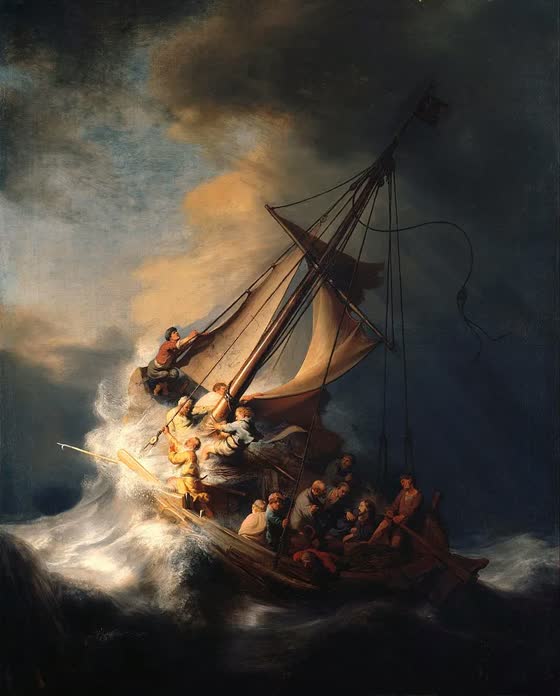
OPENING FRAME: the video begins on the reference painting exactly as it is — same crop, same composition, nothing added or removed — and the camera is already drifting into its move on frame one. There is no static beat at the start, no pause anywhere in the shot, and no moment where the camera parks.

Treat the painting as a genuine three-dimensional place. Keep every element precisely as painted: the wooden fishing boat heeled hard over on the crest of a towering foaming wave, the straining torn sail and the web of rigging on the raked mast, the crewman clinging high at the bow hauling a line, the men wrestling the canvas and rigging amidships, the calm figure of Christ seated among the frightened disciples at the stern, the helmsman braced against the rudder, the great luminous wall of breaking water at frame left, the black heaving sea beneath the hull, the storm clouds tearing open to pale light at upper left, the warm shaft of light striking the boat, the deep browns, ochres, sea-greens and bone highlights, and the visible brushwork and aged varnish of the oil surface. Faces, bodies, clothing, scale and placement are permanent — nothing shifts, nothing redesigns itself.

CAMERA — a single ten-second take, no edits, in motion from the first frame: 0.0–1.5s a gentle drift forward and slightly right, the storm splitting into depth planes as spray and dark water slide into the near field and the boat gains real volume. 1.5–4.0s the camera carries on rightward and inward, curving around the stern quarter, the vessel turning in true perspective as it moves — not the boat turning, the viewpoint travelling — passing close by Christ and the huddled disciples, wet planking and taut ropes brushing through the near field. 4.0–6.5s the arc carries the camera around the boat's far side, into the open storm between the hull and the black horizon; the seaward flank of the hull, the backs of the stern figures and the underside of the bellied sail seen from behind, the great glowing wave now viewed from inside the painting looking back through the rigging. 6.5–8.5s the circle continues, climbing slightly as it re-emerges past the bow, the man high on the rigging and the torn canvas coming back into view with the shaft of storm light breaking across the deck. 8.5–10.0s the camera eases outward and settles gently toward the original vantage, decelerating but still alive with drift on the last frame, framing matched to the opening so the clip loops without a seam.

MOVEMENT CHARACTER: flown, not computed. A faint float in the frame, small gimbal corrections, a soft roll leaning into each curve, a light buffet passing through the spray, speed that swells mid-move and relaxes at either end. Human-feeling and slightly imperfect — never a perfect mechanical rail, never glassy-smooth interpolation.

The world itself barely stirs: parallax between every layer of sea, boat and sky, slow breathing in the figures' shoulders, hands flexing faintly on ropes and rudder without moving from their holds, the sail edge trembling, fine mist drifting off the wave crest, the boat rocking almost imperceptibly in place, the paint texture faintly alive. No one stands, walks, climbs or changes their grip's position. Nothing enters the scene, nothing leaves it, no light changes. Absolutely no morphing, stretching or face distortion.

Look: cinematic 24fps, shallow focus riding whatever is nearest the lens, a grade faithful to the original chiaroscuro palette, light film grain, colours untouched. Zero text, lines, marks or watermarks in any frame. Sound is ambience only — wind through rigging, timber groaning, waves breaking low, faint spray hiss.
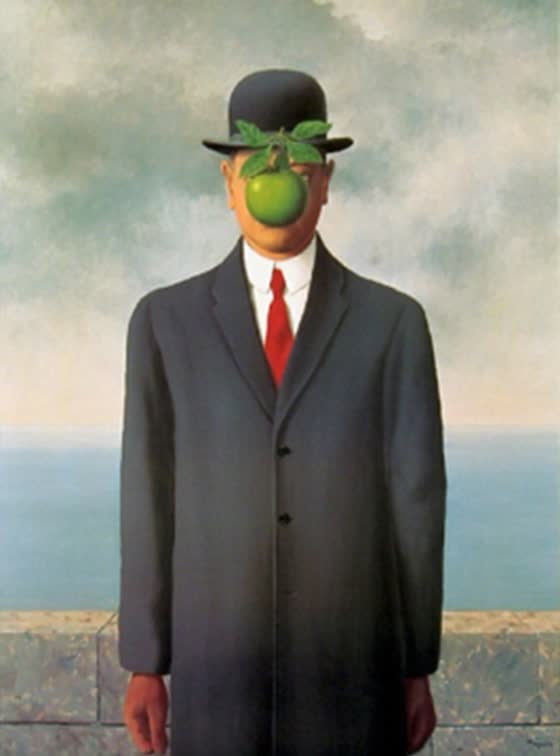
OPENING FRAME: the video begins on the reference painting exactly as it is — same crop, same composition, nothing added or removed — and the camera is already drifting into its move on frame one. There is no static beat at the start, no pause anywhere in the shot, and no moment where the camera parks.

Treat the painting as a genuine three-dimensional place. Keep every element precisely as painted: the man standing bolt upright in the charcoal wool overcoat, white collar and knotted red tie, the black bowler seated level on his head, the polished green apple hovering just in front of his face with its leaves upturned, both arms resting straight at his sides, the low grey stone parapet behind him, the flat quiet sea running to the horizon, the mottled grey-cream overcast sky, the even shadowless daylight, and the smooth clean-edged paint handling of the original. Face stays hidden behind the apple from every angle — the apple is fixed to his face like a mask and never slips. Body, clothing, scale and placement are permanent — nothing shifts, nothing redesigns itself.

CAMERA — a single ten-second take, no edits, in motion from the first frame: 0.0–1.5s a gentle drift forward and slightly right, the scene splitting into depth planes as the parapet edge slides into the near field and sea air opens behind him. 1.5–4.0s the camera carries on rightward and inward, curving around his shoulder, the man turning in true perspective as it moves — not him turning, the viewpoint travelling — the coat's wool weave passing close through the near field. 4.0–6.5s the arc carries the camera around his far side, over the stone wall and into the space between him and the water; the back of the overcoat, the rear brim of the bowler and the nape of his collar seen from behind, the whole shoreline now viewed from inside the painting looking out toward where he faces. 6.5–8.5s the circle continues, re-emerging past his left shoulder, the red tie and the green apple swinging back into view still sealed over his face, the horizon levelling behind him. 8.5–10.0s the camera eases outward and settles gently toward the original vantage, decelerating but still alive with drift on the last frame, framing matched to the opening so the clip loops without a seam.

MOVEMENT CHARACTER: flown, not computed. A faint float in the frame, small gimbal corrections, a soft roll leaning into each curve, speed that swells mid-move and relaxes at either end. Human-feeling and slightly imperfect — never a perfect mechanical rail, never glassy-smooth interpolation.

The world itself barely stirs: parallax between sky, sea, wall and figure, a slow breath in his chest, the coat hem and tie edge lifting in a whisper of sea wind, the apple leaves trembling, clouds creeping at a glacier's pace, faint far-off swells crossing the water. He never steps, turns, gestures or reveals his face. Nothing enters the scene, nothing leaves it, no light changes. Absolutely no morphing, stretching or distortion.

Look: cinematic 24fps, shallow focus riding whatever is nearest the lens, a grade faithful to the muted surrealist palette, light film grain, colours untouched. Zero text, lines, marks or watermarks in any frame. Sound is ambience only — low wind off the water, distant slow waves, quiet open air.
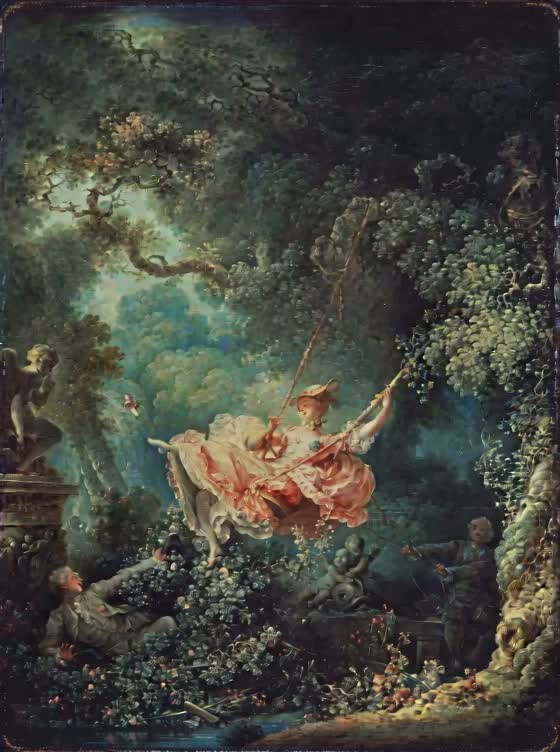
OPENING FRAME: the video begins on the reference painting exactly as it is — same crop, same composition, nothing added or removed — and the camera is already drifting into its move on frame one. There is no static beat at the start, no pause anywhere in the shot, and no moment where the camera parks.

Treat the painting as a genuine three-dimensional place. Keep every element precisely as painted: the young woman in the frothy pink silk gown and plumed straw hat seated mid-air on the crimson velvet swing, one hand on the taut rope, her slipper caught mid-flight off her pointed toe, the suitor sprawled in the rose thicket at lower left reaching up with his hat, the older man half-hidden in shadow at lower right holding the guide ropes, the stone cupid hushing with a raised finger, the putti riding the dolphin below her, the walls of deep teal foliage, the luminous blue-green clearing glowing behind her, the soft top-left light, and the visible brushwork and cracked varnish of the oil surface. Faces, bodies, clothing, scale and placement are permanent — nothing shifts, nothing redesigns itself.

CAMERA — a single ten-second take, no edits, in motion from the first frame: 0.0–1.5s a gentle drift forward and slightly right, the garden splitting into depth planes as foreground blossoms slide past the lens. 1.5–4.0s the camera carries on rightward and inward, curving around the taut rope side, the woman turning in true perspective as it moves — not her turning, the viewpoint travelling — with rose branches brushing close through the near field. 4.0–6.5s the arc carries the camera around her far side, deep into the space between her and the glowing clearing; the rear of her hat and the great pink folds of the gown seen from behind, the whole garden now viewed from inside the painting looking out. 6.5–8.5s the circle continues, re-emerging on her left, her profile and the airborne slipper coming back into view as the cupid statue rises in the background. 8.5–10.0s the camera eases outward and settles gently toward the original vantage, decelerating but still alive with drift on the last frame, framing matched to the opening so the clip loops without a seam.

MOVEMENT CHARACTER: flown, not computed. A faint float in the frame, small gimbal corrections, a soft roll leaning into each curve, speed that swells mid-move and relaxes at either end. Human-feeling and slightly imperfect — never a perfect mechanical rail, never glassy-smooth interpolation.

The world itself barely stirs: parallax between every layer of foliage, a slow breath in the woman's shoulders, lace and ribbon edges trembling, a leaf turning here and there, pollen hanging in the light shafts, the paint texture faintly alive. No one stands, walks, swings away or gestures. Nothing enters the scene, nothing leaves it, no light changes. Absolutely no morphing, stretching or face distortion.

Look: cinematic 24fps, shallow focus riding whatever is nearest the lens, a grade faithful to the rococo palette, light film grain, colours untouched. Zero text, lines, marks or watermarks in any frame. Sound is ambience only — birds far off, leaves moving, the low creak of rope on branch.